
Checking Criminal History in Fayette County
Begin with the event and the likely level of charge. The Fayette County District Clerk keeps felony files for the 155th District Court. The County Clerk keeps Class A and B misdemeanor cases. Municipal and justice courts handle many fine-only matters. The Fayette County Sheriff answers current custody and booking questions, while the Texas Department of Public Safety, or DPS, provides a statewide public conviction name search. No single screen combines every one of those records.
Use a full legal name, spelling variants, an approximate year, and a cause or booking number when known. A date of birth may help an authorized clerk distinguish similar names, but a public name match alone does not prove identity. Ask the clerk for the docket, charging instrument, judgment, sentence, and any order that limits disclosure.
- Choose the clerk, police agency, or jail that created the record.
- Search or ask by full name, date range, and known file number.
- Compare the arresting agency, court, offense, and dates.
- Pull the underlying booking sheet or court judgment.
- Order a certified copy or fingerprint self-review when identity matters.
Note: A certified Fayette County judgment carries more authority than a portal printout when the two sources appear to conflict.
Fayette Records Have Several Custodians
Fayette County places record control with the office that holds the file. The county's public-information policy does not create one central freedom-of-information desk. Sheriff reports go to the Sheriff. Filed misdemeanor matters go to the County Clerk, felony matters go to the District Clerk, and a city police report remains with that city.
The official Fayette County directory shows the starting points for this decentralized system.

The county navigation is useful because it routes a searcher to the office with legal custody rather than implying that all records sit at the courthouse.
| Record sought | Best first custodian | Key limit |
|---|---|---|
| Incident or booking | Sheriff or arresting police agency | Not a final disposition |
| Felony court file | District Clerk | Does not replace the arrest report |
| Class A or B misdemeanor | County Clerk | Fine-only city cases may be elsewhere |
| Public statewide outcome | Texas DPS | Name ambiguity and reporting gaps |
Texas Official Background Checks
DPS offers two different routes. Its public Criminal History Conviction Name Search discloses reported Texas convictions and deferred adjudications that state law makes public. Search credits cost $1 each. A card purchase adds a 2.25 percent fee per credit and a 25-cent transaction fee. DPS also lists a $10 offline name check. These products are narrower than a full identity-matched record.
A personal fingerprint review is the stronger way to inspect one's own Texas history. FAST, run through IdentoGO by IDEMIA, captures fingerprints for DPS. The published personal review cost is a $15 DPS record fee plus a $10 electronic fingerprint fee. Two hard cards alone cost $20. Confirm the service code before booking because different statutory programs route results in different ways.
| Official product | Published base cost | Best use |
|---|---|---|
| DPS online name search | $1 credit plus card fees | Public reported convictions and deferred adjudications |
| DPS offline name check | $10 | Offline form of the public product |
| DPS fingerprint review | $15 plus $10 prints | Identity-matched review of one's own record |
| FBI electronic summary | $18 plus fingerprint costs | Subject's FBI-maintained identity history |
Fayette DPS Conviction Search
The DPS conviction search requires an account and prepaid credits. Its current entry screen illustrates why a search should begin with careful name data.
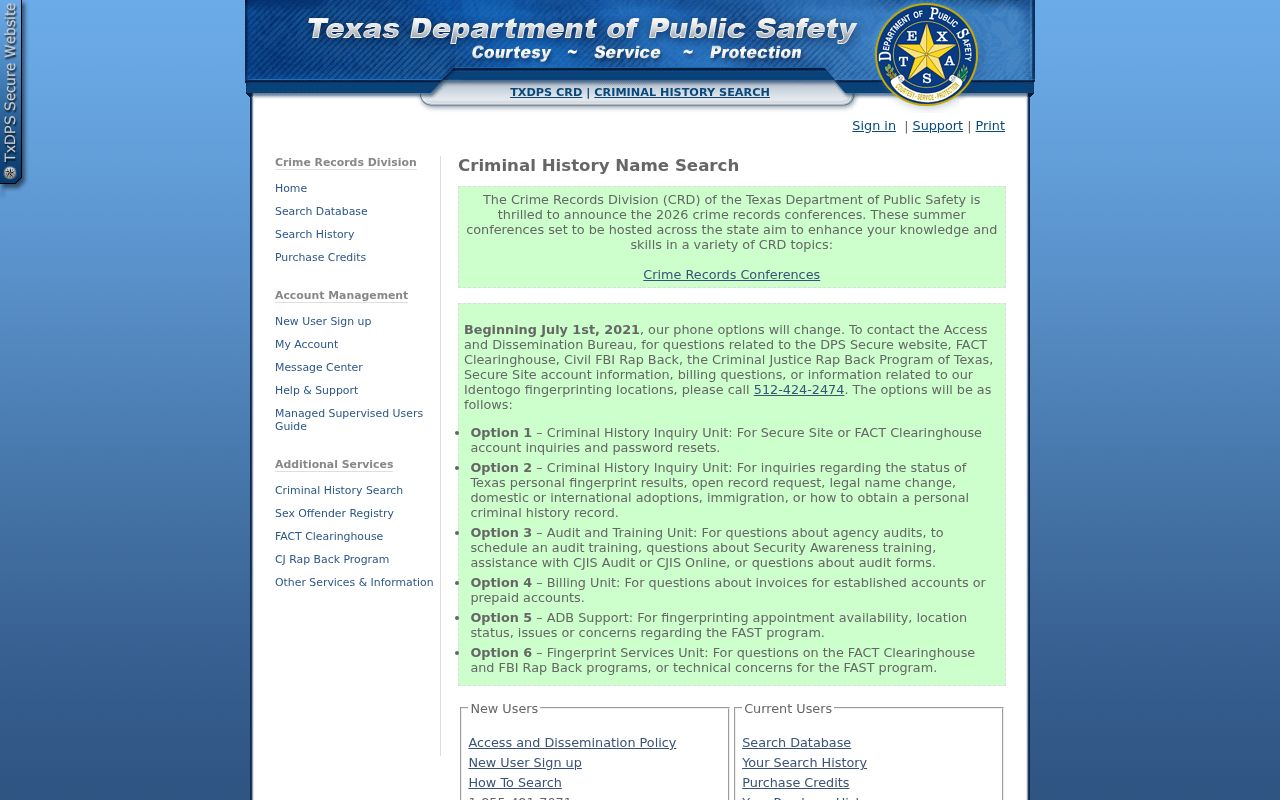
The DPS form can use surname, first name, middle name, date of birth, sex, and race where available. Exact birth data can narrow similar results, yet fingerprints remain the more reliable identity key.
The official DPS search help explains credits, account access, and matching cautions.

That help material matters because a public result is a repository entry, not a scanned Fayette County case file.
| Field | Use | Search note |
|---|---|---|
| Last and first name | Required in name mode | Try legal spelling and known variants |
| Middle name | Narrows common names | Optional |
| Date of birth | Distinguishes matches | Important when lawfully known |
| Sex and race | Optional narrowing | Portal options can vary |
| Search credit | Executes a query | Purchased before searching |
Criminal Record Types
A Fayette County criminal record is not one document. Police create incident and arrest reports. Jail staff create a booking file. A magistrate records warnings and bail action. Prosecutors and clerks create the court case, and DPS connects reportable fingerprinted arrests with submitted outcomes. TDCJ later creates state custody data when a sentence results in transfer.
- Incident report: the responding agency's account of allegations, witnesses, and evidence.
- Booking record: jail intake, initial charge, bond, and release or transfer data.
- Court file: filed charge, docket events, plea, judgment, and sentence.
- DPS history: public reported conviction or deferred-adjudication cycles.
- Custody record: county jail, TDCJ, or federal status in the proper locator.
These files can disagree without either being fabricated. An arrest charge may change after prosecutor review. A judgment may reach DPS late. A dismissal does not by itself erase the older police or booking file.
Fayette FAST Fingerprint Review
The official FAST and IdentoGO enrollment portal is the appointment route for a personal Texas fingerprint record review.
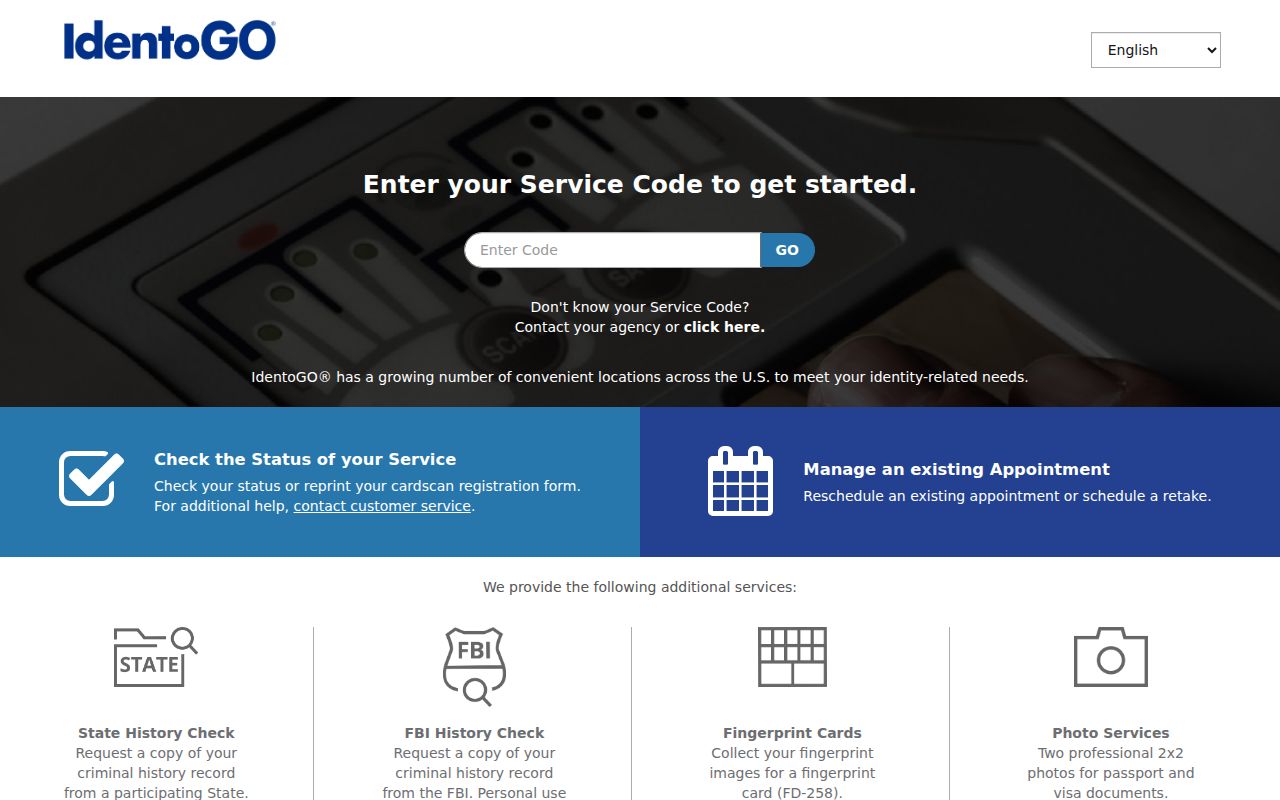
No official source confirmed an enrollment site inside Fayette County, so use the location finder only after entering the correct service code. Appointment help is available at 1-888-467-2080 from 8 a.m. to 9 p.m. Central. Preserve the transaction number and the result. If a DPS disposition is missing, obtain a certified Fayette County judgment and follow the DPS review and challenge process.
Fingerprint self-review answers an identity question. It does not supply pleadings, motion text, hearing settings, or certified local copies. Those still come from the clerk.
Inside a Fayette County Criminal Record
A Texas criminal-history cycle may link identity descriptors, an arrest event, the arresting agency, an offense code, the prosecutor, a court case number, disposition, and sentence. Public display varies by source. The court file is usually richer in procedure, while the DPS product focuses on public reportable outcomes.
| Name and identifiers | Legal name, aliases, date of birth, and state or transaction identifiers where public. |
|---|---|
| Arrest segment | Arrest date, agency, tracking number, and alleged arrest charge. |
| Court segment | Cause number, filed offense, court, prosecutor, and docket events. |
| Disposition | Conviction, deferred adjudication, dismissal, acquittal, or another recorded result. |
| Sentence | Confinement, fine, costs, restitution, or community-supervision terms when reported. |
| Limits | Protected identifiers, juvenile data, victim data, and restricted records may be absent. |
- Disposition
- The recorded outcome of a filed charge.
- Deferred adjudication
- A plea-based result in which the court delays a finding of guilt while conditions are completed.
- Capias
- A court order directing an officer to take a person into custody.
- Community supervision
- Texas's term for court-ordered probation.
Fayette Jail Record Fallbacks
No official open Fayette County jail roster was verified. Current custody checks should therefore start with the Sheriff and jail at 1646 N. Jefferson Street in La Grange, 979-968-5856. Ask for the booked spelling, booking number, arresting agency, initial charge, bond, and responsible court. A “not found” answer may mean release or transfer, not that no arrest took place.
Request the booking sheet from the Sheriff under the Texas Public Information Act. Seek the incident report from the arresting agency and the filed outcome from the right clerk. After transfer to state custody, the TDCJ Online Inmate Search can show state identifiers, current unit, conviction county, offense, sentence, and projected dates. It does not show live county bond or the full court docket.
Fayette County Sheriff and Jail
1646 N. Jefferson St.
La Grange, TX 78945
979-968-5856
Records-counter hours not published
Fayette County Clerk
246 W. Colorado St.
La Grange, TX 78945
979-968-3251
Weekdays 8-5, closed noon-1
The County Clerk page confirms the misdemeanor record counter and its access details.
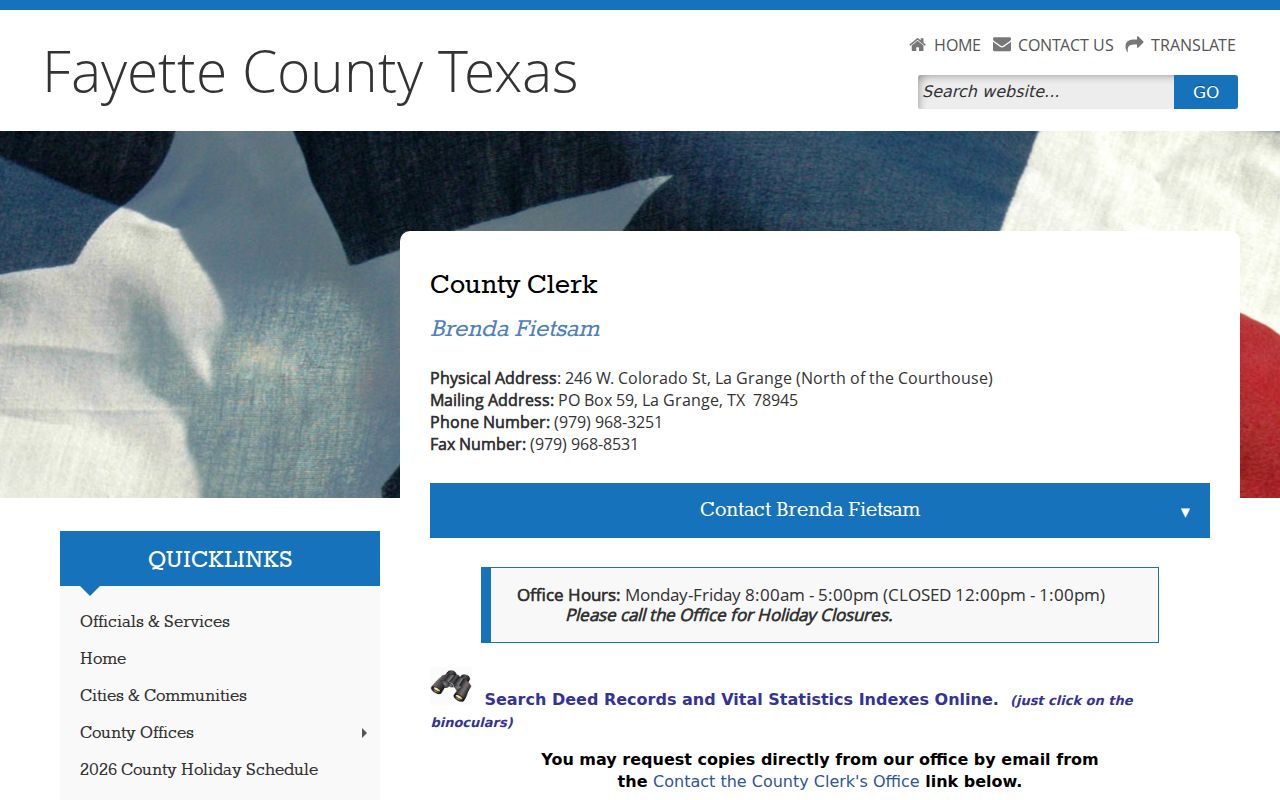
This image represents the working misdemeanor channel, not the separate District Clerk felony channel.
Public Access Laws in Texas
The Texas Public Information Act gives a right to inspect or copy public records held by government bodies, subject to statutory exceptions. It requires prompt production, but ten business days is generally the period for an agency to seek an Attorney General ruling when needed, not a fixed deadline for every response. Judicial records remain under court and clerk rules rather than operating exactly like executive-agency requests.
Key Statutes:
Government Code Chapter 552 governs requests, charges, redactions, and law-enforcement exceptions.
Government Code Chapter 411 controls public criminal-history dissemination and nondisclosure.
Code of Criminal Procedure Chapter 66 sets statewide reporting duties.
Family Code Chapter 58 protects juvenile justice information.
Ask for electronic inspection when practical and request an itemized estimate before copies are made. Active-investigation information, driver-license data, medical details, protected victim information, and confidential juvenile material may be withheld or redacted.
Fayette Warrants Cross Court Lines
A warrant search must follow the issuing authority. A district or county criminal docket may show a capias tied to a filed case. Municipal and justice courts can issue warrants in fine-only matters. The Sheriff's Office may confirm enforceable local status, but no official countywide web warrant search was found.
Call the issuing clerk before taking action. Ask whether the warrant remains active, whether an appearance is required, and which court controls bond or recall. Do not assume an online payment automatically clears a warrant. A person resolving their own warrant should rely on the court and qualified counsel, not a commercial list.
Record flow: complaint or court order › issuing court record › law-enforcement entry › service or recall › updated docket.
Note: A stale portal result can create risk, so confirm warrant status directly with the issuing court before relying on it.
Sealed, Expunged, and Restricted Records
Texas expunction under Code of Criminal Procedure Chapter 55 generally destroys or returns qualifying records. An order of nondisclosure under Government Code Chapter 411 instead limits ordinary public disclosure while allowing access by criminal-justice and other authorized entities. Eligibility differs by offense, outcome, waiting period, related criminal episode, and prior supervision. A dismissal alone does not prove that either remedy applies.
Start with certified Fayette County dispositions. An expunction petition is filed in the proper district court and identifies the arrest, charge, agency, cause number, outcome, and agencies that hold records. Local fees and a county form were not confirmed in official research, so ask the District Clerk before filing. After an order, keep certified copies and later review the court channel and a DPS fingerprint record. Send a certified order through the proper challenge route if an entry remains.
| Remedy | General effect | Verification step |
|---|---|---|
| Expunction | Qualifying records are destroyed or returned as the order directs | Check each named custodian |
| Nondisclosure | Ordinary public disclosure is restricted | Check public clerk and DPS views |
Fayette Supervision Records Split
Community supervision and parole are not the same record. Fayette County CSCD manages local court-ordered community supervision under the judgment. The public court docket may show the sentence, a motion to revoke, a motion to adjudicate, or a related warrant. Ordinary officer notes and treatment details are not a general public database.
Parole decisions come from the Texas Board of Pardons and Paroles.

The Board addresses release decisions, while the TDCJ Parole Division handles field supervision.
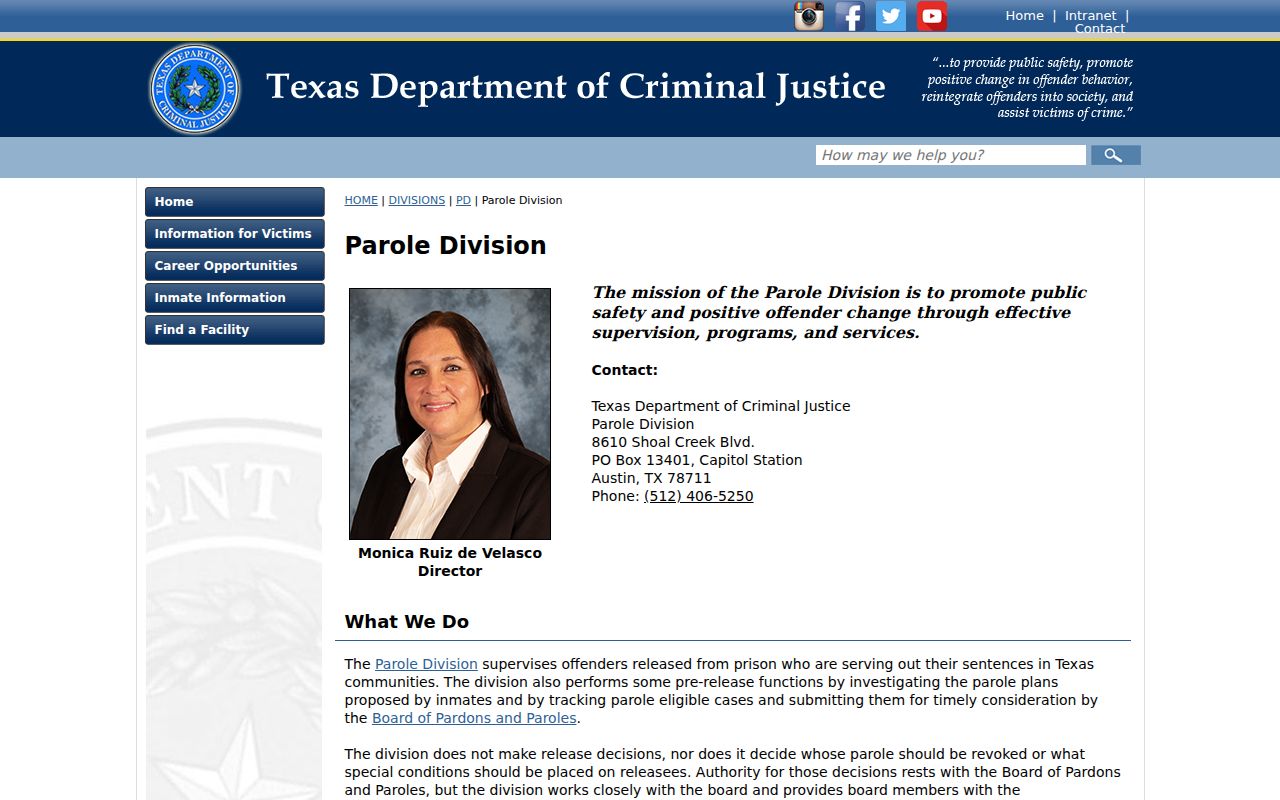
To verify status, read the judgment first, then use TDCJ resources and the official supervision office. VINELink can add custody notifications, but it is not the original jail or court record.
Fayette Federal Criminal Records
Federal cases do not sit with a Fayette County clerk. Fayette County lies in the Southern District of Texas, and federal dockets are searched through PACER. The Southern District of Texas court site identifies the proper federal court.
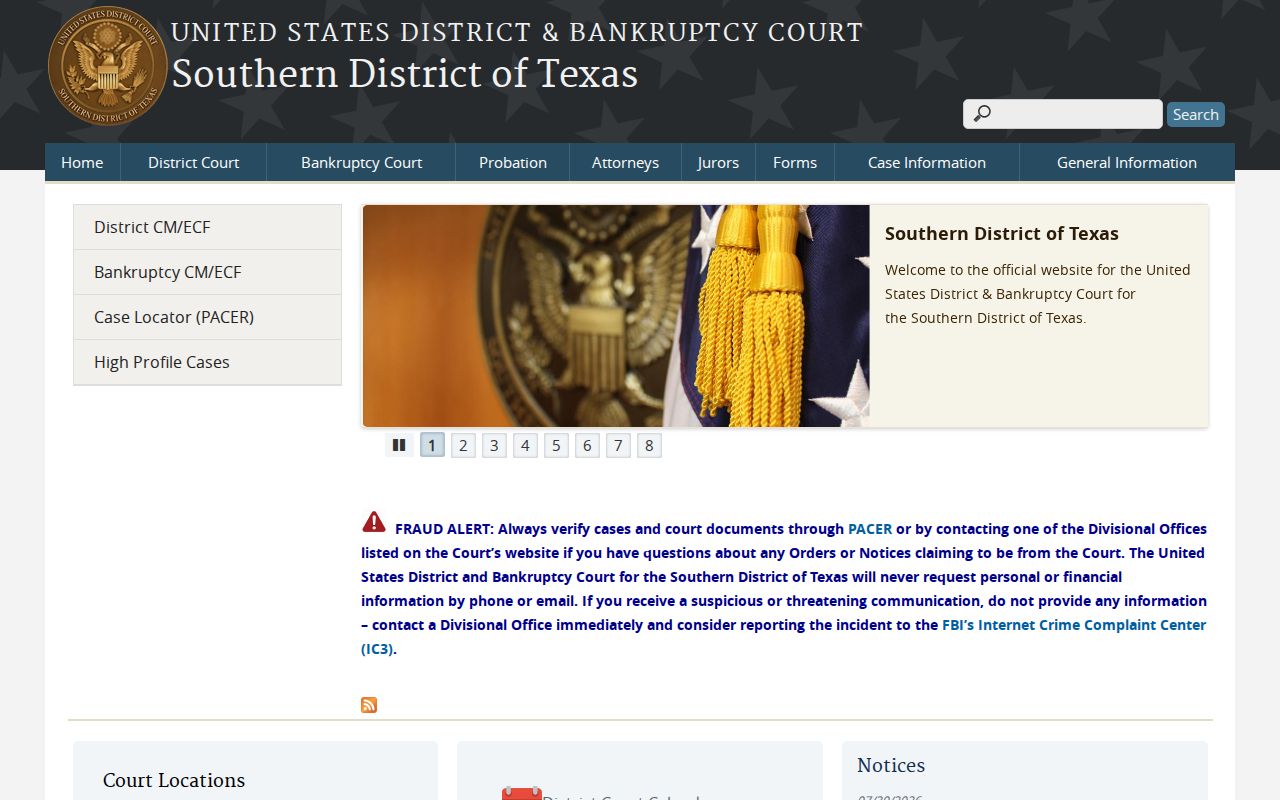
PACER requires registration and may charge its published per-page fee. CourtListener's RECAP can contain donated copies, but it is not the official docket. Federal custody uses the Bureau of Prisons locator, not Fayette County Jail or TDCJ. The FBI Identity History Summary is a subject-only record review and also does not replace a federal case docket.
Keep the layers distinct: PACER answers what was filed in federal court, the FBI summary reports identity history submitted to the FBI, and the BOP locator reports federal custody.
Fayette Records Past and Present
The 1891 J. Riely Gordon courthouse remains the county's visual center, but it is not one criminal-record counter. The working County Clerk office is north of the courthouse, the District Clerk handles the felony channel, and the operating jail is at North Jefferson Street. That split prevents a common search error.
The Texas Historical Commission record documents the historic Fayette County jail.
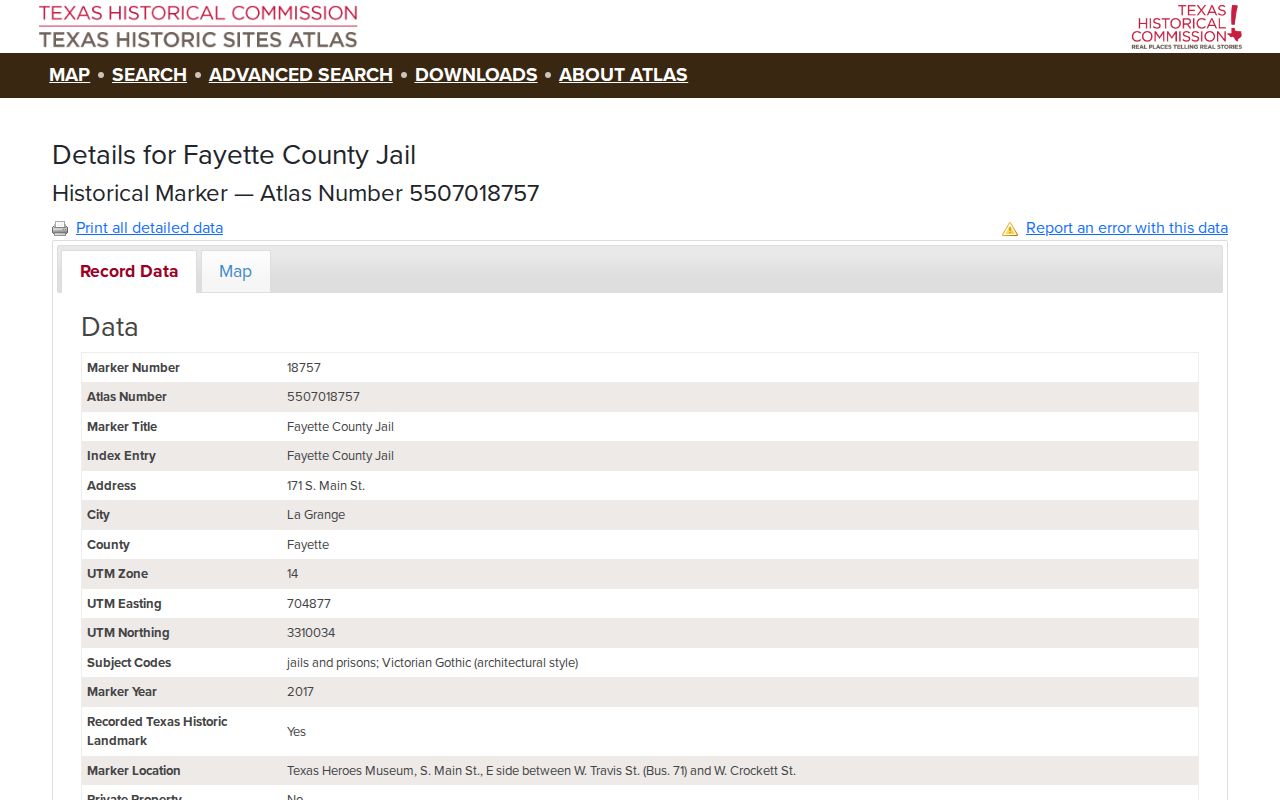
The older jail had 16 cells plus living and office space for the sheriff's family. It is a heritage site, not today's booking facility. Modern searches must use the Sheriff and current jail for custody data.
Fayette County Criminal Records by City
City police reports and municipal court files add a local layer to Fayette County criminal records. La Grange, Schulenburg, and Flatonia are the three largest incorporated cities in the 2020 Census count used by the research. Each guide identifies its police record channel, municipal court, booking route, and point where a case moves into the county system.
La Grange Criminal Records
4,391 residents · city police, municipal court, and county-seat record channels
Schulenburg Criminal Records
2,633 residents · city police and municipal court near the I-10 corridor
Flatonia Criminal Records
1,308 residents · police, municipal court, and county booking routes